End-to-end pipeline.
Drop your STL in. Get a print-ready STL back, with a verified safety factor. No external FEA, no proprietary formats, no manual setup.
Only FFF tool that closes the loopFormetric routes material exactly where the load demands it. Run a real FEA, blend four optimal TPMS patterns voxel by voxel, validate the lattice in a closed loop. Then export a print-ready STL.
STL in. Print-ready STL out. Safety factor included.
Drop your STL in. Get a print-ready STL back, with a verified safety factor. No external FEA, no proprietary formats, no manual setup.
Only FFF tool that closes the loopOther tools force one TPMS pattern. Formetric classifies each voxel by stress mode — tension, compression, shear, mixed — and blends the four optimal patterns continuously.
Only Hybrid FEM-driven infillNovineer simulates what your slicer will produce. nTop runs FEA manually. Slicers don't validate at all. Formetric is the only one that runs FEA after applying the infill.
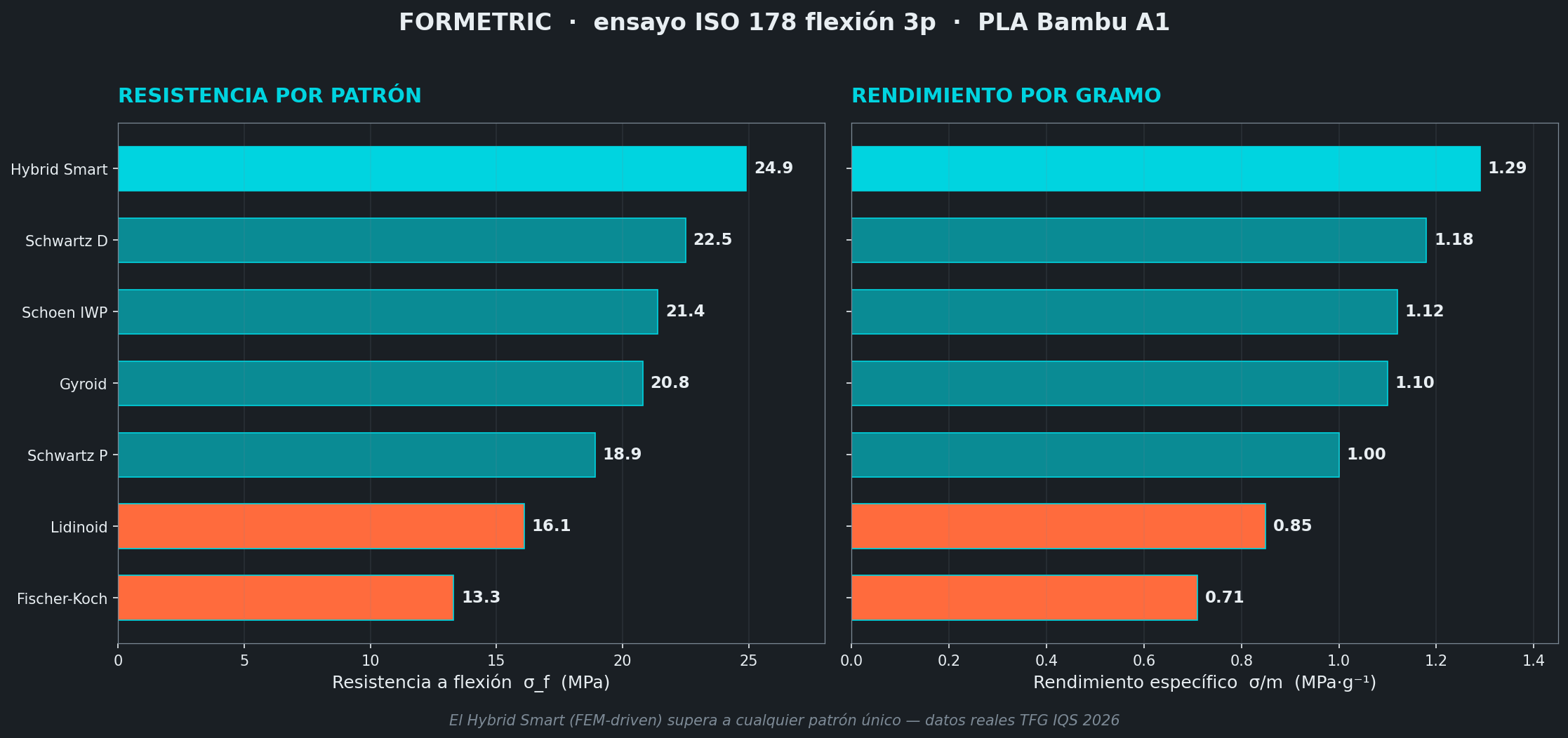
Only with closed-loop validationWe printed and broke real flexural specimens (ISO 178) of all seven patterns. The FEM-driven Hybrid won every test — 24.9 MPa, ahead of every uniform lattice. Measured on a real bench. Not extrapolated.
#1 of 7 patterns · ISO 178 lab-validatedEvery TPMS pattern has its mechanical sweet spot. Real parts have multiple stress modes in different regions. Formetric resolves a local FEA, classifies each voxel, and blends four patterns continuously — voxel by voxel, with C⁰-continuity guaranteed by construction.
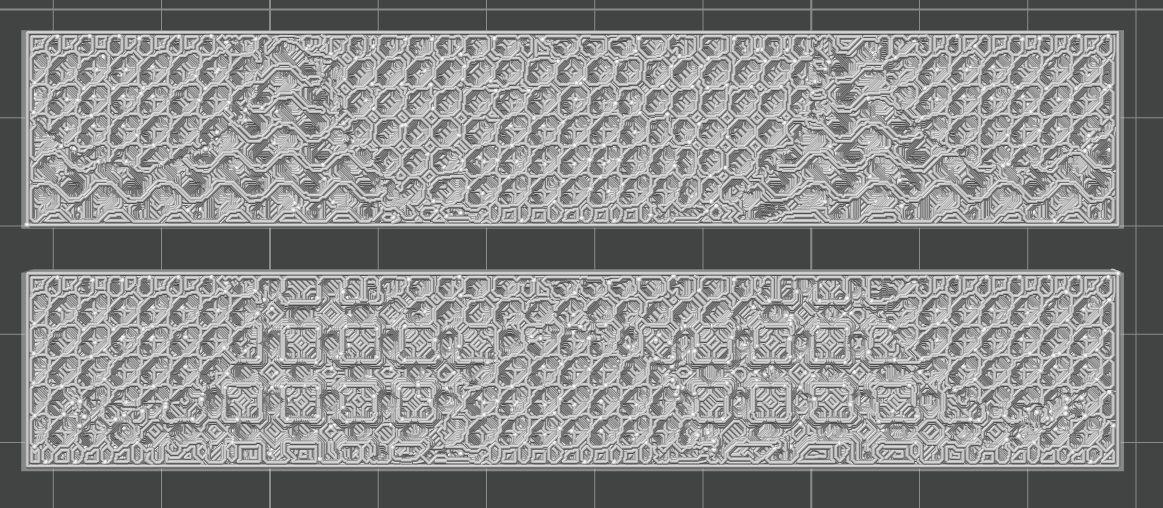
When the maximum principal stress σp1 dominates, weight shifts to IWP — a multi-axial fiber network optimized for axial pull.
When |σp3| dominates, Diamond takes over — a tetrahedral network with maximum stiffness in axial compression.
Highest shear modulus of the TPMS family. Rotated 45° to align its 4-lobe topology with the principal shear axes.
When stresses are balanced or loads unknown, Gyroid is the robust fallback — isotropic, predictable, well-understood.
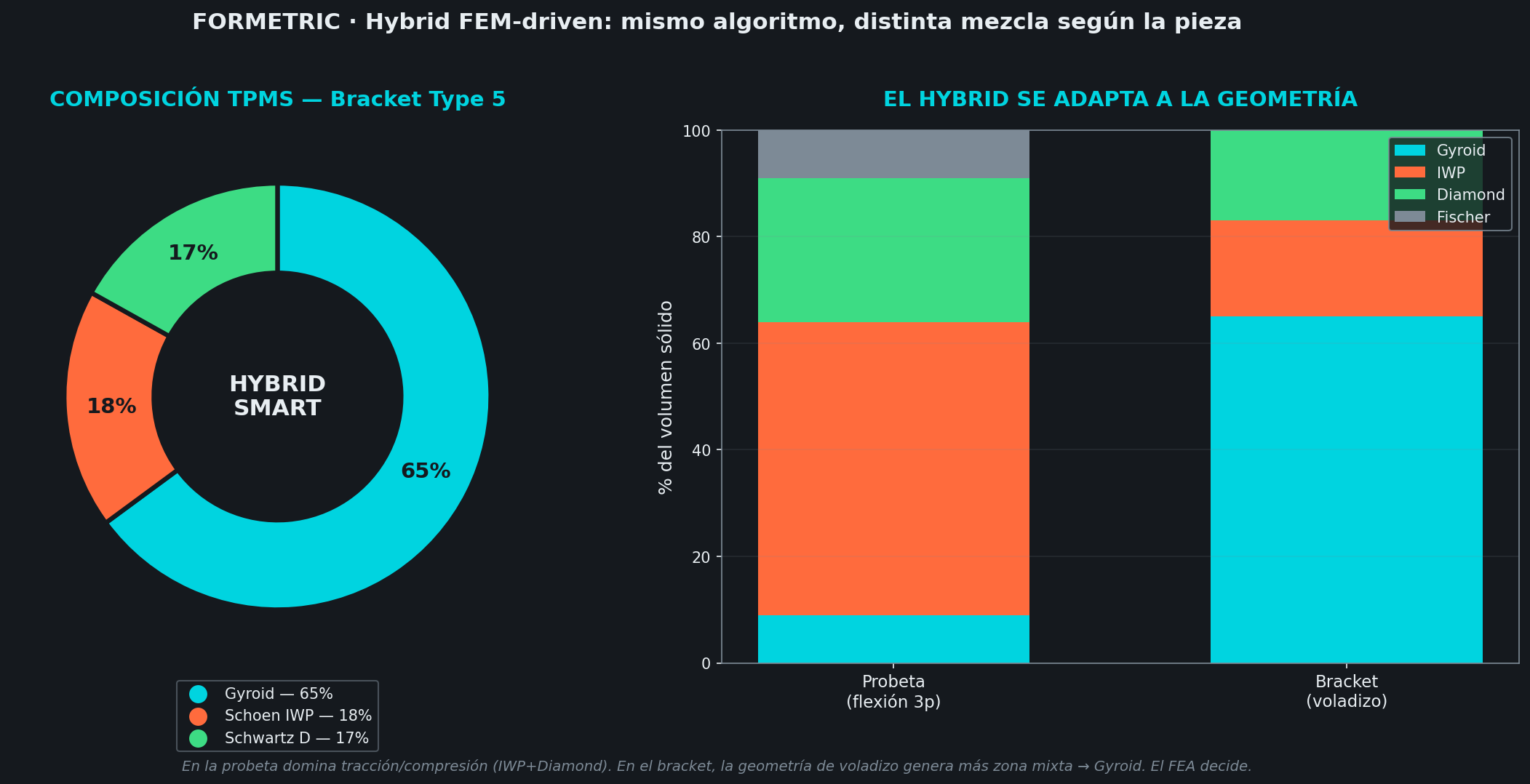
The Hybrid isn't a fixed recipe — the FEA decides the blend for each geometry. A bracket under cantilever load ends up 65% Gyroid (lots of mixed-mode regions). A simple bending specimen is dominated by tension and compression, so it lands at 55% IWP + 27% Diamond instead.
No joints, no welds — each TPMS morphs smoothly into the next.
One lattice flows into another with C¹ continuity — seamless and unbreakable.
Same engine. The geometry — through the stress field — picks the patterns. That's the whole point.
Any geometry, with or without holes. Automatic voxelization at 0.5 mm.
Click pins, click loads. Real Newtons, normal-to-surface or custom vectors.
Volumetric von Mises field. Orthotropic FDM model. Tsai-Hill criterion.
Chirped TPMS: small cells under high stress, large cells under low. Hybrid blend per voxel.
Re-FEA on the infilled part. Catch failures before pressing print. STL ready.
It vibrates, buckles, heats up, fatigues. Slicers do none of this. Formetric runs all six analyses on every part, on the same voxel grid, with an orthotropic FDM material model that knows printed PLA is not isotropic.
Volumetric von Mises with anisotropic stiffness — in-plane vs through-layer (Exy ≠ Ez). Asymmetric Tsai-Hill failure criterion that knows printed PLA isn't isotropic.
First modes of vibration. Critical for drone arms, motor brackets, anything near a resonant source.
For slender or thin-walled parts, buckling fails long before yield. Reports the eigenvalue λcr.
Steady-state and transient conduction. Surfaces near a heat source get less infill density.
Goodman criterion applied per-voxel. Critical for hinges, clips, snap-fits — anything that flexes for thousands of cycles.
SIMP integrated with chirped TPMS. Iterates the stress field with the current lattice until Δ < 5%.
We printed and broke real flexural specimens on a Bambu Lab A1, standard PLA, and ranked all seven patterns by strength. The FEM-driven Hybrid Smart — the one that mixes patterns by local stress mode — came out on top. Not a single uniform pattern matched it.
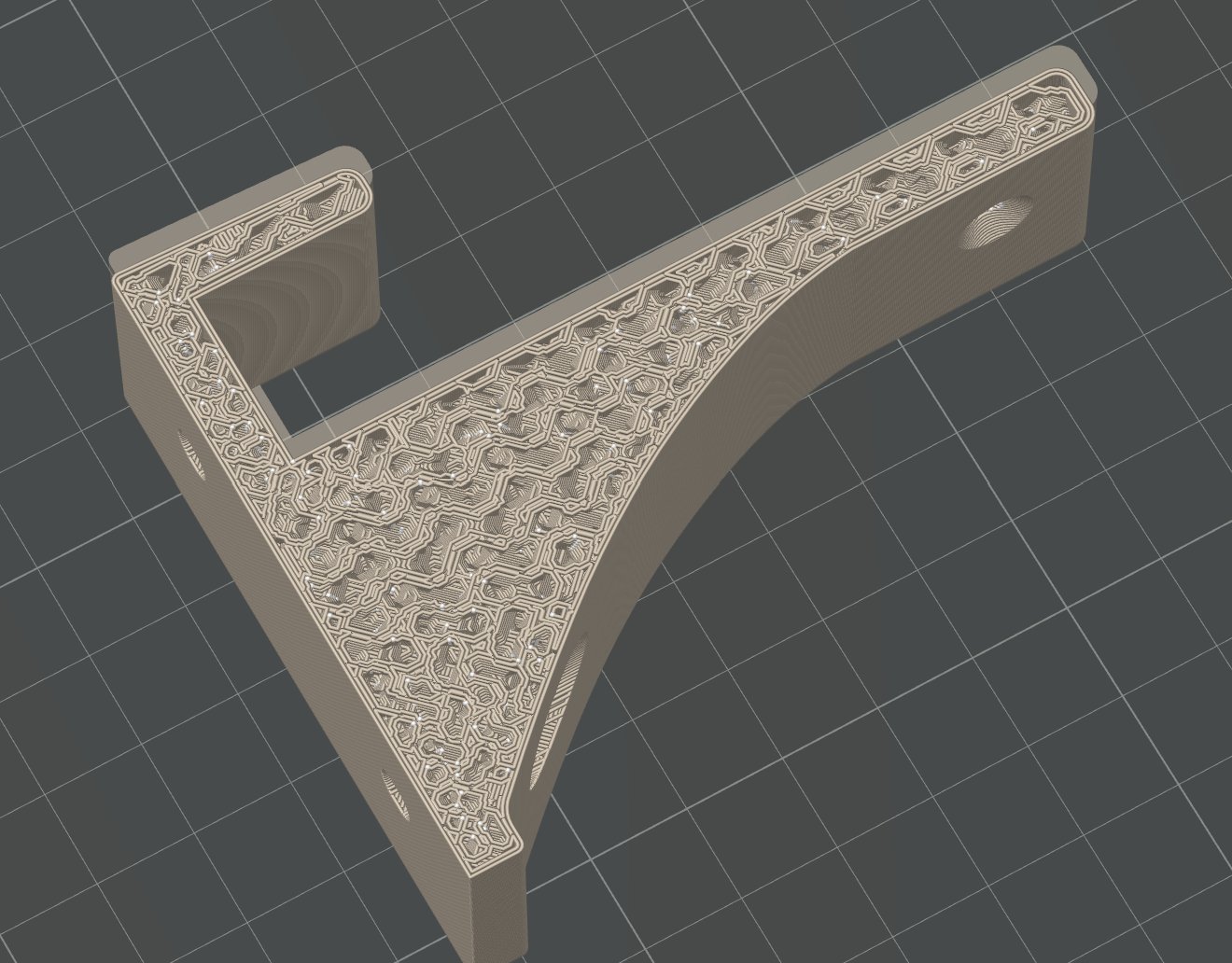
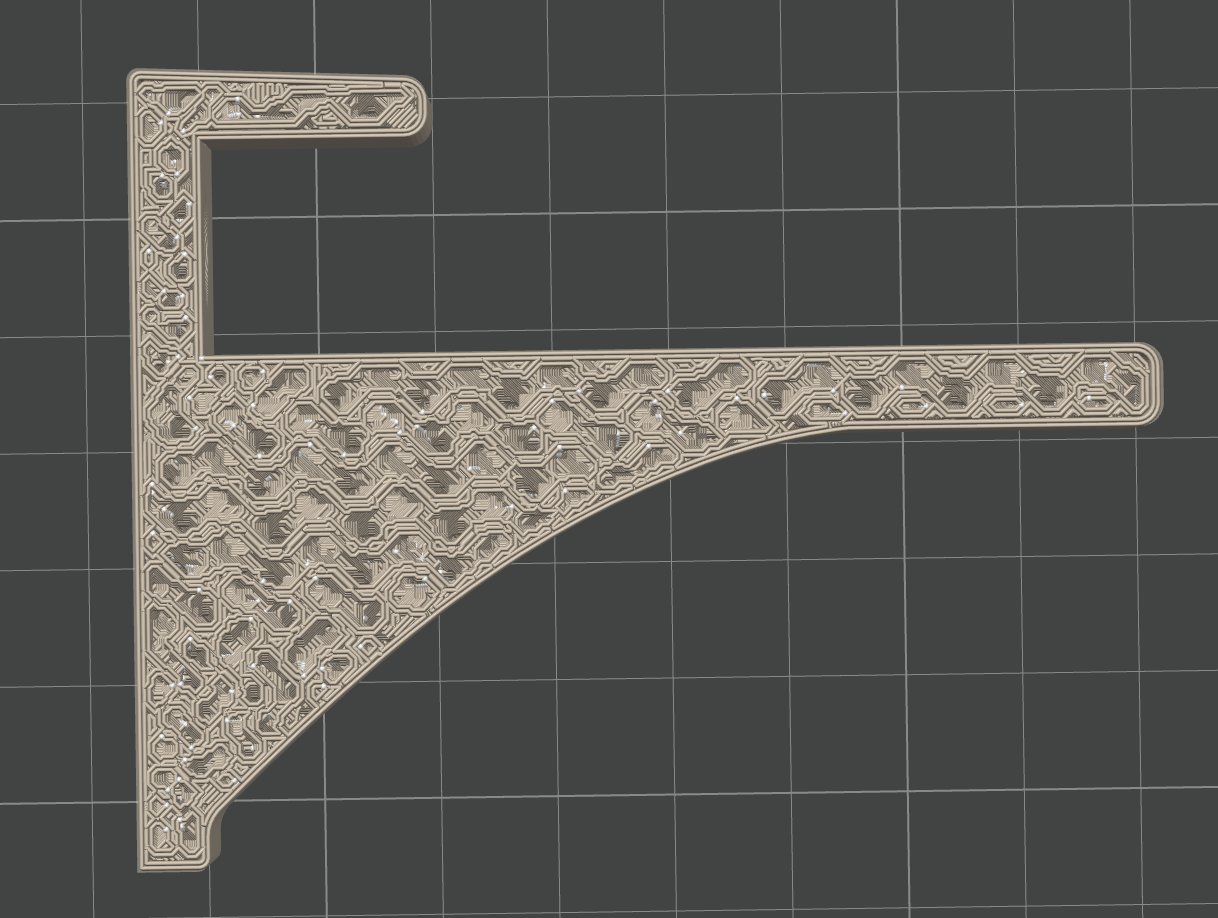
No mockups. Every clip below is the same part — Bracket Type 5 — rendered live by Formetric's own OpenGL viewer. Real FEA, real adaptive TPMS lattice. Same camera, top to bottom, telling the whole story.
A real cantilever bracket — wall plate, arm, gusset. The actual geometry you'd print, standing in its mounting orientation.
A real volumetric finite-element solve. The Tsai-Hill stress field peaks red at the fixed end where the cantilever bends hardest.
The same solve, split by sign. Red is where the part is pulled apart, blue where it's squeezed. This map decides which TPMS pattern goes where.
A section cut reveals the real TPMS infill inside the shell — dense at the fixed end, hollowing out toward the free tip. The FEA decided the density.
| Feature | Formetric | stecs3D | nTop | Novineer (NoviPath) | Slicers (Bambu / Cura) |
|---|---|---|---|---|---|
| FFF/FDM-native workflow | ✓ | ✓ | ✗ general-purpose | ✗ Stratasys only | ✓ |
| Hybrid FEM-driven infill (4 TPMS blended) | ✓ unique | ✗ | ✗ | ✗ | ✗ |
| Orthotropic FDM material model | ✓ Exy ≠ Ez · Tsai-Hill | isotropic | ✓ (manual) | partial | isotropic |
| Modal · Buckling · Thermal · Fatigue | ✓ all four | ✗ | ✓ (manual) | ✗ | ✗ |
| FEA-driven adaptive infill | ✓ | partial | manual setup | analyzes only | ✗ |
| Continuous gradient (vs. discrete zones) | ✓ | 4 discrete zones | ✓ (manual) | ✗ | ✗ |
| Closed-loop post-infill validation | ✓ unique | solid-only FEA | multi-step manual | predicts, no redesign | ✗ |
| TPMS patterns supported | 7 + Hybrid | 2–3 | many (build yourself) | none | 1 (gyroid) |
| Direct STL in / out | ✓ | proprietary | proprietary implicit | G-code only | G-code only |
| Real Newtons (not abstract scales) | ✓ | relative | ✓ (manual) | ✓ | ✗ |
| Lab-validated, Hybrid beats every pattern | ✓ #1 of 7 · ISO 178 | — | — | — | — |
Formetric is in private beta. We're onboarding engineers printing structural parts on FFF machines — brackets, drone arms, fixtures, end-effectors. Bring your STL. We'll send you the optimized version, plus the FoS report.